
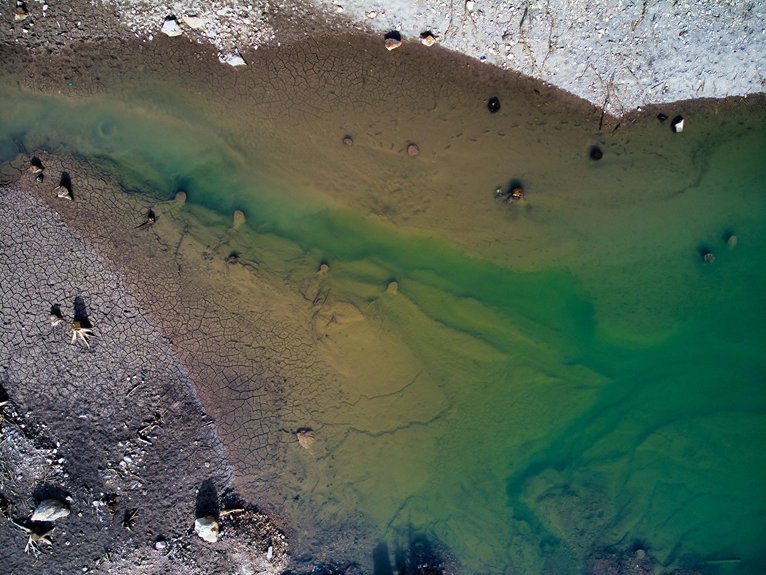
Sediment buildup in residential lakes accelerates eutrophication by storing and recycling nitrogen- and phosphorus-rich fine particles. Organic-rich deposits increase oxygen demand, drive anoxic conditions, and trigger release of iron-bound phosphorus at the sediment–water interface. Wind, bioturbation, and gas ebullition resuspend these particles, returning bioavailable nutrients to the water column and sustaining cyanobacterial blooms even after watershed inputs decline. Understanding these internal loading mechanisms clarifies why chronic algae problems persist and what controls are most effective.
Although lakes naturally support photosynthetic microorganisms, algal blooms arise when physical, chemical, and biological controls on growth become imbalanced, primarily through excess nutrient loading. Elevated inputs of bioavailable nitrogen and phosphorus shift systems from nutrient-limited to light- or grazing-limited, enabling rapid cyanobacterial and algal proliferation. Empirical studies show chlorophyll‑a concentrations scaling predictably with total phosphorus, often following hyperbolic loading–response curves. Hydrodynamics and thermal structure further regulate bloom formation. Stable stratification, weak mixing, and elevated temperature enhance nutrient recycling within the euphotic zone and favor buoyant taxa. Concurrently, disruption of zooplankton grazing pressure—via fish community shifts or contaminants—reduces top‑down control. These coupled feedbacks create self-reinforcing high-biomass states, where minimal additional loading can trigger abrupt, system-wide bloom events. As sediments accumulate and recycle nutrients back into the water column, they intensify eutrophication processes that drive persistent, high-biomass algal blooms in residential lakes.
In residential lakes, the same nutrient surpluses that drive algal blooms also accelerate sediment accumulation by increasing organic production and deposition to the basin floor. Excess nitrogen and phosphorus from stormwater inflows, fertilized lawns, and leaky septic systems stimulate high primary productivity, generating elevated fluxes of senescent algal biomass and macrophyte litter.
Simultaneously, urbanization increases mineral sediment delivery via erosive runoff from construction sites, compacted soils, and degraded shorelines. Fine particulates, often <63 μm, remain in suspension longer, then settle under low-energy conditions, forming a cohesive, low-permeability layer.
Reduced circulation in coves, shallow embayments, and behind decorative structures further promotes particle settling. Over time, these processes rapidly infill basins, decrease mean depth, and create physically unstable, deposition-prone zones.
As sediment accumulates on the lake bottom, it functions as a long‑term phosphorus sink and, under many conditions, a potent internal source. Incoming particles adsorb dissolved phosphate onto iron, aluminum, and calcium mineral phases, creating a stratified “nutrient archive” that can persist for decades. Sediment cores from residential lakes frequently show phosphorus concentrations several-fold higher than in overlying water, confirming this storage function.
Key mechanistic features of this nutrient trap include:
Sediment that initially sequesters phosphorus frequently becomes a chronic nutrient source that sustains algal production long after external inputs are reduced.
Over time, organic-rich deposits thicken, oxygen demand increases, and redox conditions at the sediment–water interface shift. Under anoxic or low-oxygen conditions, iron-bound phosphorus is reductively dissolved and released as soluble reactive phosphorus.
This internal loading is further amplified by bioturbation, gas ebullition, and wind-driven resuspension that continuously recycle fine particles into the water column. Temperature stratification, pH fluctuations, and microbial mineralization rates modulate the timing and magnitude of these releases, creating seasonally pulsed phosphorus fluxes.
The result is a self-reinforcing feedback loop in which legacy sediment stores sustain recurrent algae blooms despite upstream nutrient controls.
A lake exhibiting a sediment-driven impairment often shows a shift from clear-water, macrophyte-dominated conditions to chronically turbid, algae-dominated states, even under stable or declining watershed nutrient inputs. From a diagnostic perspective, sediment problems manifest as altered light regimes, disrupted thermal structure, and internal nutrient recycling that decouple the lake from external loading trends.
Although sediment and nutrient loading is often framed as a watershed-scale issue, many chronic inputs originate from routine neighborhood activities and small, distributed sources. Impervious surfaces accelerate stormwater runoff, hydraulically mobilizing fine particulates from streets, driveways, and construction sites into storm drains and then directly into lakes.
Poorly stabilized shorelines, bare soils in common areas, and eroding landscape beds contribute suspended sediments with attached phosphorus.
Fertilizer misapplication on lawns and ornamental plantings elevates dissolved inorganic nitrogen and bioavailable phosphorus, especially when products are applied before rainfall. Pet waste and grass clippings left on hard surfaces further increase nutrient flux.
Aging stormwater infrastructure, undersized detention basins, and clogged vegetated swales reduce sedimentation efficiency, converting neighborhood drainage networks into persistent sediment and nutrient delivery systems.
When excess sediment is the primary driver of algal blooms, symptomatic “quick fixes” typically fail because they do not disrupt the underlying mass-balance dynamics of nutrients and light within the water column. Algaecides, dyes, and short-term aeration regimes may transiently suppress chlorophyll-a but leave intact the internal loading engine embedded in fine, nutrient-rich sediments.
Persistent failure of symptom-focused controls underscores the need to directly modify the sediment compartment that sustains internal nutrient loading and turbidity. Technically credible options fall into three categories: removal, isolation, and in-situ transformation.
Mechanical dredging and hydro-dredging physically export legacy phosphorus, organic fines, and contaminated floc, resetting sediment budgets but at high capital and disposal costs.
Mechanical and hydraulic dredging remove legacy phosphorus and contaminated fines, resetting sediment loads but demanding substantial capital and disposal investments
Sediment capping with inert or sorptive materials (e.g., sand, alum-bentonite, lanthanum-modified clays) suppresses diffusion and resuspension, effectively lowering soluble reactive phosphorus flux.
In-situ amendment approaches deploy aluminum, iron, or calcium-based binders to immobilize porewater nutrients and alter redox-sensitive binding equilibria.
Emerging strategies integrate oxygenation of surficial sediments with tailored sorbents, targeting both chemical release pathways and bioturbation-driven resuspension.
While in-lake sediment controls address legacy loads, the primary determinant of long‑term turbidity and nutrient delivery remains sediment generation and routing from the watershed and shoreline interface. Effective practices target hydraulic energy, particle detachment, and transport pathways before sediments reach the littoral zone.
How can lake management move beyond reactive treatments toward durable control of sediment and algal biomass?
Long‑term plans increasingly rely on integrated, data‑centric frameworks. Managers establish baseline bathymetry, sediment thickness, and nutrient mass balances, then model internal loading from anoxic hypolimnia and wind‑driven resuspension. Multi‑year strategies combine targeted dredging, phosphorus inactivation (e.g., alum, lanthanum‑modified clays), and hypolimnetic oxygenation or circulation to disrupt release of legacy nutrients.
Lake managers now pair detailed sediment mapping with multi‑year, targeted in‑lake treatments to interrupt legacy nutrient release.
Decision‑support systems synthesize high‑frequency sensor data, remote sensing, and watershed export models to optimize intervention timing and dosage. Adaptive management loops—monitor, analyze, recalibrate—are codified in 5–20‑year implementation schedules with explicit performance metrics: Secchi depth, chlorophyll‑a, total phosphorus, and cyanotoxin thresholds.
Capital planning then aligns infrastructure upgrades, sediment removal cycles, and shoreline retrofits to maintain resilient, clear-water states.
Aeration or fountains alone typically cannot prevent sediment-driven blooms; they enhance oxygenation and mixing but rarely disrupt internal phosphorus loading, legacy nutrient reservoirs, or fine-particle resuspension, necessitating complementary interventions like alum treatment, dredging, or engineered biogeochemical capping solutions.
Professional sediment removal for a small residential lake (1–5 acres) typically ranges from $20,000–$150,000, driven by dredging method, mobilization, dewatering logistics, sediment volume (cubic yards), contaminant profile, disposal pathways, and regulatory permitting complexity.
Homeowners can safely deploy DIY sediment assays using mail‑in geochemical panels, handheld turbidity meters, and colorimetric phosphorus/nitrogen kits. For innovation‑oriented monitoring, low‑cost portable XRF units and smartphone‑integrated spectrophotometric tests quantify metals, organics, and nutrient loading with acceptable screening precision.
Yes. Ichthyofaunal “distress events” can stem directly from sediment accumulation via gill-clogging particulates, contaminant desorption (e.g., legacy metals, pesticides), redox-driven ammonia and sulfide release, and hypolimnetic oxygen depletion, even in the relative absence of conspicuous algal proliferation.
A residential lake should be professionally assessed at least annually; high‑nutrient, rapidly infilling, or heavily used systems warrant quarterly monitoring to track trophic state, sediment accretion rates, dissolved oxygen dynamics, and early signals of ecological regime shifts.
In the end, the lake behaves like an overloaded reactor: sediments as capacitors, quietly storing legacy phosphorus, release it like a slow electrical leak that powers recurring algal “surges.” Without dredging the submerged archives, interrupting watershed sediment inputs, and recalibrating nutrient loading, each summer bloom is not an accident but a deterministic output. The system’s equations are clear: unmanaged sediment is the hidden driver that keeps the lake’s eutrophication algorithm running. For more information on how Clean Flo can improve the health of your lake or pond, visit us online at Clean Flo. You can also check out our video series on our YouTube channel.