
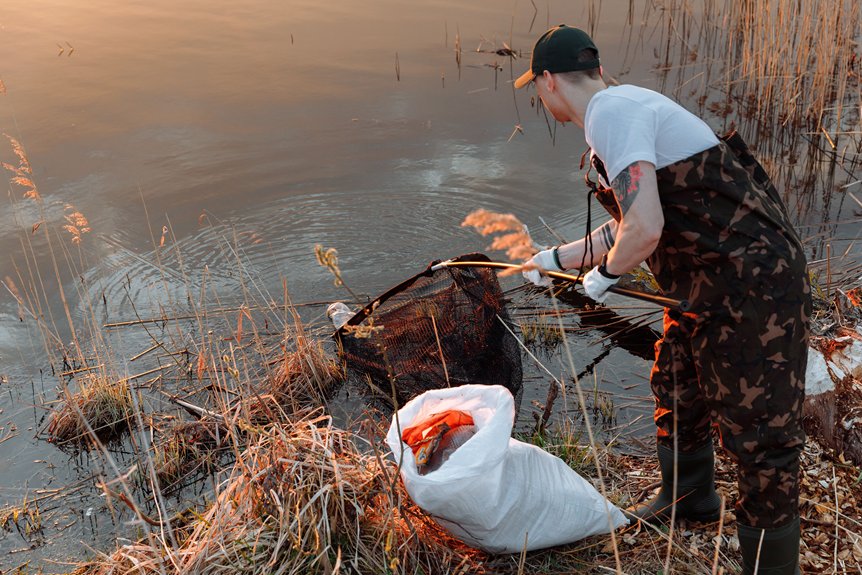
North Carolina lake restoration success stories highlight community‑driven, data‑centered projects that measurably cut nutrient loads and harmful algal blooms. Western mountain reservoirs report 35–55% phosphorus reductions via hypolimnetic oxygenation and alum, while Piedmont urban lakes show 20–45% chlorophyll‑a declines and better Secchi depth. Coastal systems use hydrodynamic re‑engineering and living shorelines to enhance flushing and resilience. These efforts also create job‑years per dollar invested, and additional examples illustrate how similar outcomes are being achieved elsewhere.
When evaluating lake restoration outcomes in North Carolina, success is defined less by anecdotal improvement and more by quantifiable ecological, chemical, and socio-economic metrics. Core indicators include sustained reductions in total nitrogen and phosphorus loads, increased Secchi depth, and stabilization of dissolved oxygen profiles throughout the water column. Biotic responses—such as higher Shannon diversity indices for phytoplankton and macroinvertebrates, resurgence of native macrophytes, and improved fish age-class structure—signal ecological resilience rather than temporary recovery. From a systems perspective, successful projects also meet design life projections for infrastructure, demonstrate cost-effectiveness via lifecycle analyses, and lower long-term management liabilities. Finally, multi-year datasets must verify that nutrient budgets, sedimentation rates, and contaminant levels remain within thresholds aligned with designated use classifications and climate-change stressors. In addition, projects that maintain phytoplankton balance and measurably reduce hypoxia demonstrate that deeper water habitats and overall lake health are being sustainably restored.
Building on these performance-based definitions of success, lake restoration in North Carolina increasingly reflects locally driven, technically sophisticated initiatives rather than top‑down, one‑size‑fits‑all projects. Community watershed associations, utilities, and local governments are deploying adaptive management frameworks that integrate continuous water‑quality monitoring, remote sensing, and hydrodynamic modeling.
Citizen-led groups are leveraging low-cost sensors, open-source data platforms, and GIS‑based decision support tools to target nutrient load reductions at sub‑basin scales. Municipalities are pairing green infrastructure retrofits with in‑lake interventions such as hypolimnetic oxygenation and alum treatments, calibrated through pre‑ and post‑project trend analysis.
Cross‑sector collaboratives routinely align restoration designs with TMDL implementation plans, climate‑resilience metrics, and ecosystem service valuation, creating replicable, evidence‑driven templates for other regions.
Although Western North Carolina is often defined by its high-gradient headwater streams rather than large impoundments, the region now hosts some of the state’s most technically advanced lake restoration projects.
High-elevation reservoirs near Asheville and Boone have piloted integrated watershed–in‑lake treatments, combining precision bathymetric mapping, sediment budget modeling, and targeted shoreline stabilization.
High-elevation reservoirs pioneer integrated watershed–in‑lake restoration, uniting advanced mapping, sediment modeling, and precision shoreline stabilization
Projects at small municipal lakes have documented 35–55% reductions in internal phosphorus loading using hypolimnetic oxygenation and alum flocculation, verified through multi-depth water quality profiling.
Bioengineered coves, planted with native facultative macrophytes, have reduced bank erosion by up to 70%, based on cross-section surveys.
Stakeholders leverage continuous monitoring buoys, high-frequency sondes, and remote data acquisition to dynamically adjust aeration regimes, validate load-reduction credits, and de‑risk future climate-driven hydrologic variability.
Western North Carolina’s high-elevation reservoirs provide a technical template now being adapted to the Piedmont’s densely developed urban lakes, where eutrophication pressures are more directly linked to stormwater-driven nutrient inflows and high shoreline imperviousness.
In Charlotte, Greensboro, and the Triangle, monitoring shows total phosphorus routinely exceeding 40–60 µg/L and chlorophyll‑a spiking above recreational thresholds during summer stratification.
Managers are deploying watershed-scale green infrastructure, retrofitted stormwater control measures, and high-rate media filtration to intercept particulate and dissolved nutrients.
In‑lake, hypolimnetic oxygenation, laminar-flow circulation, and targeted alum dosing are being calibrated via continuous sonde data and diel oxygen profiling.
Early results indicate 20–45% chlorophyll‑a reductions, fewer cyanobacterial dominance events, and measurable recovery of Secchi depth without sacrificing urban recreational use.
As coastal development and sea‑level rise intensify stress on North Carolina’s estuarine fringe, restoration of coastal and tidal lakes bordering Albemarle and Pamlico Sounds is increasingly driven by salinity gradients, wind‑driven mixing, and episodic storm surges rather than classic stratification dynamics.
Interventions now prioritize hydrodynamic re‑engineering: selectively breaching relic dikes, installing low‑crested living shorelines, and configuring inlet controls to dampen saline intrusion while preserving tidal exchange.
Monitoring indicates post‑project shifts toward brackish, submerged aquatic vegetation assemblages, reduced shoreline erosion rates, and improved residence‑time metrics for nutrient flushing.
Coupled hydrodynamic–biogeochemical models guide siting of fringing marsh creation and oyster‑reef sills to maximize wave attenuation and denitrification, positioning these coastal lake systems as adaptive buffers in a rapidly changing sound‑side landscape.
Coastal and tidal lake projects along Albemarle and Pamlico Sounds illustrate how hydrodynamic re‑engineering and nature‑based infrastructure can stabilize stressed systems. Parallel efforts are now emerging inland where residents, municipal staff, and local NGOs co‑design and implement restoration.
Across North Carolina, several community-accessible lakes now function as living laboratories.
At Lake Johnson in Raleigh, retrofitted forebays, bioengineered shorelines, and floating wetlands demonstrate nutrient interception and wave‑energy attenuation.
Lake Tomahawk in Black Mountain exhibits littoral‑zone revegetation, stormwater bioretention cells, and public monitoring stations displaying turbidity and chlorophyll-a trends.
In Greensboro, Country Park Lake integrates fish‑community restructuring with aeration upgrades, improving dissolved oxygen profiles.
These sites are open to visitors, offering in situ observation of applied limnology, adaptive management, and citizen-science protocols.
While on‑the‑ground work is visible in shoreline plantings and aeration systems, the enabling framework for these North Carolina lake projects is a layered mix of federal grants, state revolving funds, municipal capital budgets, and private cost‑share contributions.
Beneath visible shoreline fixes lies a complex financing mosaic powering resilient North Carolina lake restoration
Clean Water State Revolving Fund loans are frequently blended with 319 Nonpoint Source grants to de‑risk early engineering and watershed modeling.
Public–private partnerships structure capital stacks so homeowners’ associations, utilities, and conservation non‑profits leverage state dollars at ratios approaching 3:1.
Philanthropic foundations underwrite feasibility studies, stakeholder mapping, and sensor networks that validate performance benchmarks.
Regional Councils of Governments often act as fiscal agents, aggregating small communities into multi‑jurisdictional proposals.
This consortium model reduces transaction costs, standardizes permitting pathways, and accelerates deployment of replicable restoration templates.
The measurable outcomes from North Carolina’s lake restoration projects are documented across water quality metrics, biotic indices, and local economic indicators. Total phosphorus and nitrogen loads have declined by double‑digit percentages in several restored impoundments, while Secchi depth and dissolved oxygen profiles indicate improved stratification stability and reduced hypoxia duration. Chlorophyll‑a concentrations show marked attenuation of harmful algal bloom frequency.
Biological monitoring reports increased Index of Biotic Integrity scores, with higher richness of sensitive macroinvertebrate taxa and reestablishment of native macrophyte communities. Fisheries surveys document rebounds in sport fish recruitment and age‑class structure, signaling enhanced trophic balance.
Economically, project corridors exhibit measurable gains in recreation‑driven revenue, seasonal employment, and small business formation linked to ecotourism and lake‑adjacent services.
Building on documented gains in water quality, biotic integrity, and local economics, North Carolina’s lake restoration portfolio now offers a set of transferrable practices that other communities can adapt to their own hydrologic and socio-economic contexts. Cross-case analysis highlights design elements that consistently correlate with improved trophic status, habitat complexity, and cost-effectiveness.
North Carolina’s lake restorations offer adaptable, proven strategies for enhancing water quality, ecology, and community prosperity
Although large‑scale restoration projects often appear institutionally driven, lake recovery in North Carolina frequently begins with coordinated local action grounded in technical data and regulatory frameworks. Residents typically initiate involvement by forming watershed associations that compile baseline limnological datasets—Secchi depth, chlorophyll‑a, nutrient ratios, and harmful algal bloom metrics—using open‑source monitoring protocols.
Engaged stakeholders then interface with state agencies and stormwater utilities to align community goals with Total Maximum Daily Load (TMDL) requirements, 303(d) listings, and municipal separate storm sewer system (MS4) permits.
Technical volunteers frequently analyze land‑use patterns with GIS, model runoff scenarios, and quantify pollutant load reductions from green infrastructure retrofits.
Entrepreneurs and civic technologists may pilot sensor networks, machine‑learning prediction tools, or nature‑based treatment systems, positioning local lakes as testbeds for scalable innovation.
Restored lakes typically increase adjacent property values 10–25%, driven by enhanced ecosystem services, visual amenities, and recreational capacity. They catalyze mixed-use development, compress vacancy rates, and reposition submarkets toward higher-income residents, shifting capitalization rates and long-term real estate investment trajectories.
Post-restoration, lakes demand perpetual babysitting: adaptive management plans, bathymetric surveys, nutrient‑loading audits, aeration calibration, vegetative buffer upkeep, invasive biota control, sedimentation monitoring, and periodic dredging—otherwise trophic status, water clarity, and biotic indices regress toward pre-restoration baselines.
Health risks for nearby residents are typically low but may include transient airborne particulates, noise, and temporary water-quality fluctuations; rigorous monitoring, best-management practices, and clear risk-communication protocols effectively mitigate exposure pathways during active restoration operations.
Restorations typically trigger temporary restrictions: over 60% of projects implement no‑wake zones and seasonal angling limits. Managers recalibrate boating access, fishing quotas, and permit conditions to protect habitat recovery trajectories, water-quality benchmarks, and long‑term recreational carrying capacity.
Yes. Restoration projects can explicitly integrate cultural and historical lake uses via stakeholder mapping, cultural resource inventories, and heritage impact assessments, informing design of access corridors, interpretive infrastructure, and zoning that preserves traditional practices while meeting ecological performance metrics.
Taken together, these North Carolina case studies function almost like a statewide “dashboard,” quantifying restored trophic states, reduced internal loading, and improved biotic indices. From western oligotrophication efforts to coastal nutrient trading frameworks, outcomes are measurable, repeatable, and—crucially—funded through diversified portfolios. Future stakeholders, armed with GIS, remote sensing, and, anachronistically, slide rules of watershed math, can replicate these interventions, scaling evidence-based lake restoration across additional basins with high confidence in performance metrics. For more information on how Clean Flo can improve the health of your lake or pond, visit us online at Clean Flo. You can also check out our video series on our YouTube channel.