
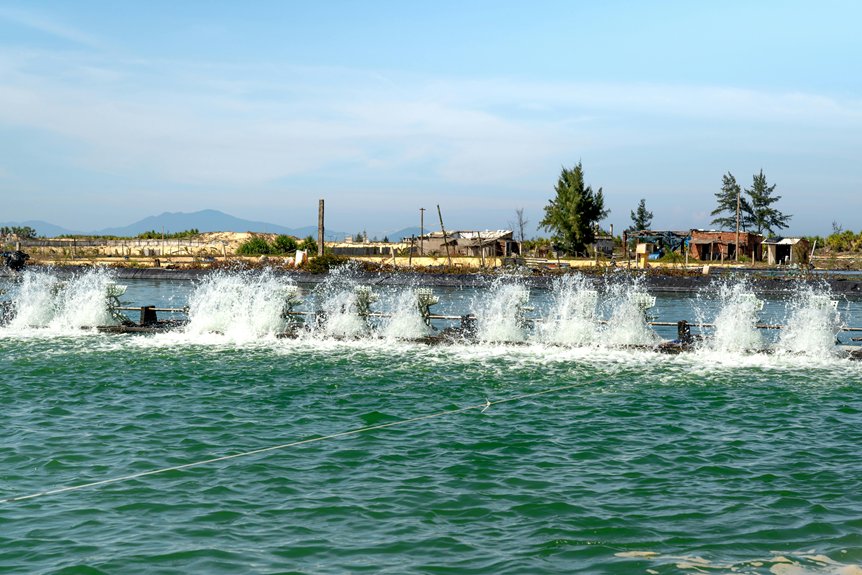
Lake aeration solutions for Dallas HOA communities and private lakes focus on engineering dissolved oxygen stability under North Texas heat, nutrient loading, and TCEQ standards. Properly sized surface or bottom-diffused systems reduce fish kills, algae, odors, and internal phosphorus release while supporting 90–100% DO saturation in upper waters and ≥2–3 mg/L at sediments. Solar, fountain, and hybrid configurations, guided by bathymetry and DO profiling, help protect asset value, aesthetics, and regulatory compliance, as outlined in greater detail below.
Although many Dallas lakes appear healthy on the surface, consistent aeration is a critical control measure for maintaining water quality, ecological balance, and regulatory compliance in HOA and private lake systems. North Texas waterbodies experience thermal stratification, leading to hypoxic bottom layers, internal nutrient loading, and periodic fish kills. Aeration mitigates these risks by elevating dissolved oxygen, enhancing microbial degradation of organics, and stabilizing pH. For HOAs, aeration reduces algal blooms, odor complaints, and sediment accumulation, directly impacting amenity value and liability exposure. From a regulatory perspective, proactive aeration supports compliance with Texas surface water quality standards, especially regarding chlorophyll-a, dissolved oxygen, and nuisance conditions. Data-enabled aeration platforms further allow continuous performance tracking, optimizing energy use while documenting environmental due diligence. In addition to boosting oxygen, well-designed aeration systems support phytoplankton balance, helping to curb eutrophication and maintain long-term lake health.
With the benefits of aeration established, effective performance in Dallas HOA and private lakes depends on sizing and designing systems to match site-specific hydraulic and ecological conditions. The process begins with bathymetric mapping, volumetric calculations, and seasonal dissolved oxygen (DO) profiling, including night and late‑summer measurements.
Designers typically target 90–100% DO saturation in upper waters and at least 2–3 mg/L at the sediment‑water interface. From these objectives, they calculate cubic feet per minute (CFM) of air and number of diffusers required using oxygen transfer efficiency data.
Texas water quality standards, stormwater permits, and reclaimed‑water reuse constraints inform the design envelope.
Advanced systems may integrate variable‑speed compressors, SCADA telemetry, and sensor‑driven control to optimize energy, noise, and compliance.
Because many Dallas-area HOA lakes are shallow, heavily landscaped, and highly visible, surface aeration often represents the most practical and publicly acceptable option for improving water quality. High-efficiency floating fountains, horizontal aspirators, and low-profile surface circulators can deliver 1.5–3.0 lbs O₂/hp-hr, supporting Texas Commission on Environmental Quality (TCEQ) dissolved oxygen objectives while enhancing aesthetics.
Selection is typically based on surface area, average depth under 10 feet, hydraulic retention time, and power availability. Multi-nozzle fountains allow tailored spray patterns and lumen outputs to meet nighttime safety and dark-sky considerations.
Variable-frequency drives and smart controls can modulate runtimes in response to temperature, chlorophyll-a, or ORP data, reducing energy costs and avoiding over-aeration that may resuspend sediments or nutrients.
When HOA or private lakes in the Dallas area exceed roughly 10–12 feet in depth, bottom diffused aeration generally becomes the most efficient and hydraulically effective approach to restoring and maintaining stratified waterbodies.
By releasing compressed air through self-cleaning membrane diffusers on the lakebed, these systems induce strong vertical circulation, destratify the water column, and increase dissolved oxygen (DO) at depth, where anoxia and internal nutrient loading typically originate.
For Dallas HOAs facing TCEQ-related water quality expectations, bottom diffusers help stabilize DO above 5 mg/L, mitigate fish kills, and curb phosphorus release from sediments.
Data-logged controllers, variable-frequency compressors, and zoned diffuser arrays enable adaptive operation, energy optimization, and targeted treatment of coves, deep holes, and stormwater-influenced basins.
Beyond deep-water bottom diffusion, many Dallas HOA lakes and ponds require surface-focused or power-constrained solutions. Making solar-driven systems, floating fountains, and hybrid configurations important components of a thorough aeration strategy.
Solar aeration leverages high regional insolation, delivering 4–8+ hours of peak performance daily without grid extensions. It can be coupled with battery storage to stabilize dissolved oxygen (DO) during critical pre-dawn hours.
Floating fountains provide high-oxygen transfer at the air–water interface, improve circulation in shallow coves, and contribute to cyanobacteria and mosquito suppression. They also meet aesthetic expectations and light ordinances.
Hybrid systems integrate bottom diffusers with solar or grid-powered fountains. This enables adaptive operation under ERCOT demand-response events while supporting water-quality compliance with TCEQ narrative nutrient and DO criteria.
A financially realistic aeration plan for a Dallas HOA lake must balance upfront capital expenditures, long-term operating costs, and regulatory risk, rather than focusing on equipment price alone. Boards increasingly request lifecycle cost analyses that quantify energy consumption, diffuser replacement intervals, and potential fines or remediation expenses if water quality degrades below TCEQ or municipal standards.
Financially realistic aeration plans weigh lifecycle costs, energy use, and regulatory risk—not equipment price in isolation
Annual maintenance typically includes compressor service, airline integrity checks, diffuser cleaning, and water-quality monitoring (DO, temperature profiles, nutrients, chlorophyll-a).
Predictive maintenance using telemetry and SCADA-style dashboards is becoming standard, reducing emergency callouts and optimizing runtimes.
When choosing a management partner, HOAs should prioritize firms offering certified lake managers, documented performance metrics, GIS-based asset mapping, nutrient-source diagnostics, and transparent reporting aligned with Texas stormwater and MS4 compliance frameworks.
Lake aeration reduces mosquito populations by disrupting stagnant breeding zones and enhancing larval mortality, thereby decreasing bite incidence and pathogen risk. Residents experience improved outdoor comfort, fewer nuisance insects, and better odor control, aligning with best-practice vector management and environmental compliance.
Aeration systems can often integrate with existing irrigation or reclaimed‑water infrastructure via shared pumps, manifolds, SCADA controls, and power. Engineers must verify hydraulic capacity, backflow prevention, TCEQ compliance, water-rights constraints, and energy-optimization opportunities before configuring multiuse conveyance networks.
Yes; adjacent homes may experience limited compressor hum and beacon glare, though modern systems use sub-60 dB enclosures, low-glare LEDs, timers, and directional shielding, often meeting municipal nuisance ordinances and dark-sky guidelines while preserving operational performance.
Aeration installations in Dallas typically require city lake-use authorization, possible U.S. Army Corps of Engineers review, electrical and trenching permits, stormwater compliance, and verification with Texas Commission on Environmental Quality regarding water-quality impacts and diffuser/intake placement near protected habitats.
An HOA builds support by sharing data-driven visuals, brief regulatory summaries, and pilot results. For example, a Frisco community hosted lakeside demos showing 40% algae reduction and improved dissolved oxygen, then surveyed residents, achieving overwhelming approval for full-system deployment.
In Dallas-area HOA and private lakes, properly designed aeration is essential infrastructure—not optional. Research indicates that maintaining dissolved oxygen levels above 6 mg/L can reduce nuisance algal biomass by up to 40%, significantly decreasing chemical treatment needs. By tailoring system design to factors such as depth, surface area, and regulatory requirements, and partnering with a qualified, locally experienced management team like Clean Flo, communities can enhance water quality, protect aquatic habitats, and effectively manage long-term operations and compliance costs. For more information on how Clean Flo can improve the health of your lake or pond, visit us online at Clean Flo. You can also check out our video series on our YouTube channel.