
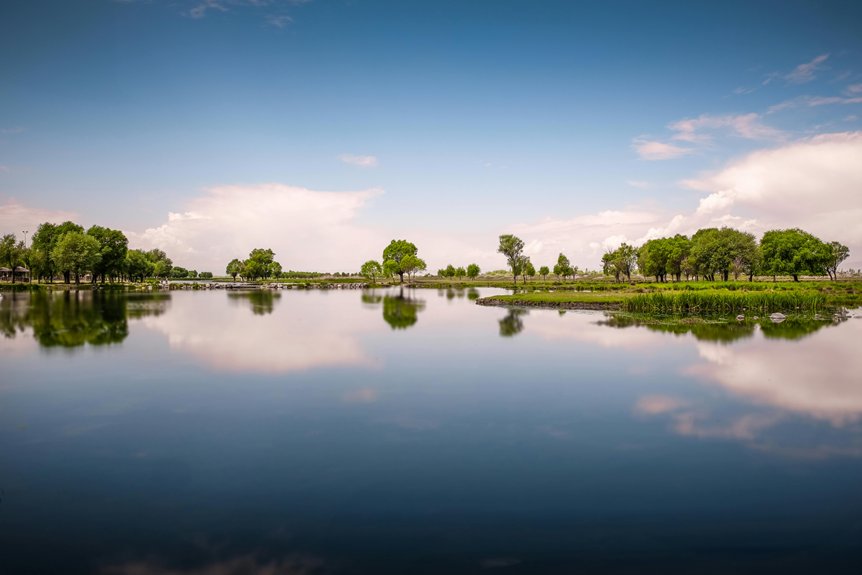
Lake restoration and water quality improvement in Wylie, TX focuses on reducing nutrient and sediment inputs from suburban runoff, aging infrastructure, and upstream agriculture. Projects use advanced stormwater treatment, green infrastructure, and in-lake tools like destratification, aeration, and sediment management to control algal blooms and low-oxygen zones. Shoreline bio-stabilization and habitat enhancements further improve ecological function and protect property. Residents can assist through fertilizer reduction, native landscaping, and pollution prevention, and there is much more underway across local lakes.
While Wylie’s lakes remain critical assets for regional water supply and recreation, multiple converging stressors are degrading water quality, most notably excess nutrient loading, accelerated sedimentation, and watershed-driven pollutant inputs.
Nutrients originate from suburban fertilizer use, malfunctioning or aging wastewater infrastructure, and upstream agricultural runoff, driving chlorophyll-a increases and seasonal algal blooms.
Sediment loads rise with rapid impervious-cover expansion, channel incision, and construction-site erosion, reducing storage capacity and light penetration.
Nonpoint-source contaminants—including hydrocarbons, heavy metals, and de-icing chemicals—enter via stormwater networks lacking advanced treatment.
Legacy pollutants trapped in benthic sediments can be resuspended during high-flow events.
Climate variability intensifies stratification, low-oxygen zones, and episodic fish kills, indicating a system highly sensitive to both hydrologic extremes and incremental land-use change.
As these pressures mount, lakes increasingly exhibit eutrophication symptoms such as hypoxia, nuisance algal blooms, and rising treatment costs that threaten long-term recreational use and ecosystem health.
A thorough lake restoration strategy in Wylie is not merely an environmental initiative but a core public infrastructure investment that underpins drinking water reliability, public health, and regional economic performance. Impaired reservoirs increase treatment costs, accelerate asset depreciation, and elevate risks of disinfection byproducts and toxin events, directly affecting utility budgets and regulatory compliance.
Economically, clear, biologically balanced lakes support property values, recreational spending, and tourism-linked employment. Studies in comparable U.S. regions indicate lake clarity improvements can raise adjacent property values by 5–15%, expanding the municipal tax base.
Health outcomes also improve as pathogen and algal toxin loads decline, reducing gastrointestinal and dermatological incidents. Consequently, lake restoration functions as a high-return, risk-mitigation tool for Wylie’s long-term growth trajectory.
Because Wylie’s primary reservoirs serve both drinking water and recreation, local lake restoration programs rely on a coordinated suite of in‑lake and watershed-based strategies calibrated to measurable performance targets. Practitioners emphasize nutrient load reductions, sediment control, and oxygen regime optimization, guided by multi-year monitoring datasets and hydrodynamic–water quality models.
Watershed strategies include green infrastructure retrofits, high‑efficiency stormwater treatment (e.g., media filters, biofiltration cells), targeted detention basins, and agricultural best management practices that reduce phosphorus and suspended solids at the source.
In‑lake tools focus on selective withdrawal and destratification to manage temperature and dissolved oxygen profiles, sediment capping in hotspot legacy deposits, and structural habitat enhancements that stabilize shorelines. Continuous sensors, remote sensing, and data dashboards support adaptive management and transparent performance verification.
Although nutrient and sediment controls are foundational, lake managers in Wylie TX still confront recurrent blooms of cyanobacteria, nuisance macrophyte growth, and the spread of invasive aquatic species that threaten drinking water reliability and recreational use.
Despite strong watershed controls, Lake Wylie still battles harmful algal blooms, nuisance weeds, and invasive species.
Current programs emphasize high-frequency monitoring of chlorophyll‑a, phycocyanin, and submerged vegetation coverage using in-situ sondes, drones, and satellite imagery to trigger rapid-response treatments. Data guide selective algaecide applications, hydrogen-peroxide–based oxidants, and ultrasonic or nanobubble systems that suppress cyanobacteria while protecting non-target biota.
For rooted weeds, managers combine GPS-guided mechanical harvesting with targeted systemic and contact herbicides, validated through pre‑ and post‑treatment biomass surveys.
Invasive species management increasingly applies eDNA surveillance, risk-ranking models, and boat decontamination protocols to contain introductions and optimize eradication efforts.
While open-water treatments target in-lake symptoms, durable water quality gains in Wylie TX depend heavily on stabilizing eroding shorelines and rebuilding littoral habitat structure. Engineered bio-stabilization systems—combining geogrids, coir logs, and native deep-rooted vegetation—can cut bank erosion rates by 60–90%, reducing suspended solids and attached nutrient loading.
Designs increasingly use graded, low-slope benches that dissipate wave energy from fluctuating reservoir levels while creating shallow, vegetated shelves. These shelves support macrophyte beds, invertebrate communities, and juvenile fish refuge, improving biotic integrity indices.
Rock toe protection is strategically integrated only where shear stresses exceed vegetation thresholds.
Remote sensing, UAV-based shoreline surveys, and LiDAR-derived erosion models guide placement of stabilization treatments and habitat modules, optimizing cost-performance and long-term resilience.
An effective lake restoration strategy in Wylie TX depends not only on engineered interventions but also on measurable behavior changes by watershed residents. Household actions can notably lower nutrient and contaminant loading.
Residents who convert traditional turf to native, deep-rooted vegetation can reduce irrigation demand by up to 50% and stormwater runoff volumes by 30–70%, according to comparable watershed studies.
Adoption of phosphorus-free fertilizers, precise application rates, and rain‑sensor smart controllers further minimizes diffuse pollution.
Proper disposal of oils, chemicals, and pharmaceuticals prevents trace-organic contamination.
Participation in citizen science—such as Secchi depth readings, shoreline photo monitoring, and app-based algae reporting—provides low-cost, high-frequency data for managers.
Coordinated neighborhood campaigns can be tracked via reduction targets in fertilizer sales, irrigation use, and reported pollutant incidents.
Typical projects span 9–24 months from assessment through post-construction monitoring, depending on lake size, sediment load, and regulatory permitting. Accelerated timelines leverage advanced modeling, modular aeration, in-situ treatment chemistries, and phased implementation to compress schedules while maintaining ecological performance metrics.
“Measure twice, cut once” applies: projects are governed by Wylie ordinances, Collin County floodplain rules, TCEQ water-quality and 401 certifications, USACE Section 404 permits, and potentially ESA, NPDES, and state stormwater construction regulations.
They rely on mixed funding: municipal capital-improvement allocations, stormwater utility fees, county cost‑share, state (TCEQ, TPWD) and federal (EPA 319, FEMA) grants, plus public‑private partnerships, phased in multi‑year CIP budgets aligned with performance milestones.
Lake restoration may indirectly influence insurance and property taxes: insurers could recalibrate risk models (flood, erosion) while assessors may adjust valuations if amenities, ecosystem services, or perceived resilience improve. Impacts remain jurisdiction-specific, requiring localized actuarial and fiscal impact studies.
Project success is quantified via water-quality metrics, habitat indices, sediment analyses, and recreational-usage statistics, then reported through dashboards, public datasets, and periodic performance briefs highlighting trend lines, benchmark comparisons, regulatory compliance status, and adaptive-management adjustments for continuous innovation.
In Wylie, lake restoration functions as a finely tuned laboratory, where each intervention—nutrient load reduction, shoreline stabilization, habitat enhancement, and invasive species control—is a tested variable improving system performance. As monitoring data document declining pollutant levels and improved biotic indices, the long‑term trajectory becomes clear: coordinated management, supported by informed residents, can measurably restore water quality, safeguard public health, and strengthen the local economy through resilient, high‑functioning aquatic ecosystems. For more information on how Clean Flo can improve the health of your lake or pond, visit us online at Clean Flo. You can also check out our video series on our YouTube channel.