
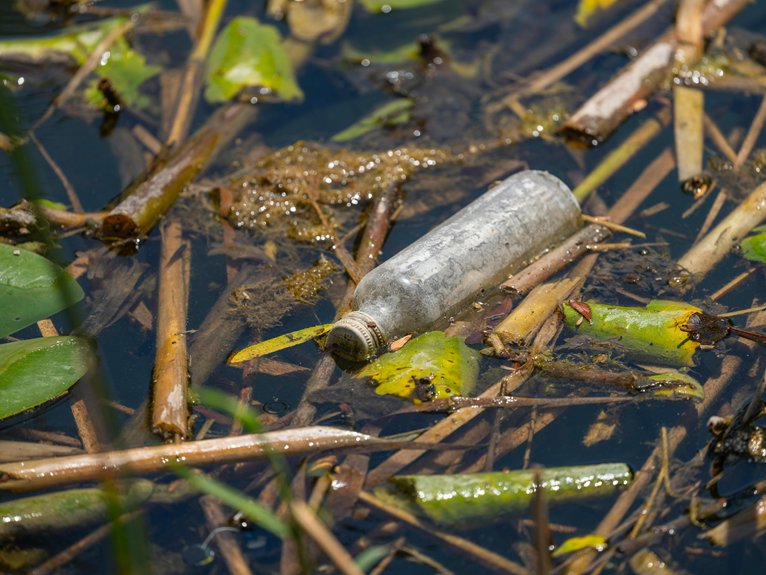
Sherwood Lake’s long-term water quality is most threatened by stormwater runoff, shoreline erosion, nutrient buildup, development-related pollution, boating activity, and failing septic systems. These pressures increase phosphorus, nitrogen, sediment, hydrocarbons, and bacteria, while also reducing water clarity and destabilizing oxygen conditions. Warmer water and internal phosphorus release further intensify algae growth and ecological stress. Fish health, habitat quality, and lake resilience decline as these factors interact over time. The sections ahead explain how each threat develops.
Why is Sherwood Lake’s water quality increasingly vulnerable over the long term? Evidence points to interacting ecological stressors that progressively reduce resilience.
Rising water temperature can lower dissolved oxygen, accelerate internal nutrient cycling, and extend conditions favorable to algal productivity.
At the same time, shifts in aquatic vegetation can alter habitat structure, concentrate organic matter, and influence diurnal oxygen swings as plant growth and decay intensify.
Sediment accumulation further compounds risk by storing phosphorus and releasing it under low-oxygen conditions.
Extended dry periods may reduce flushing, increasing pollutant residence time and chemical concentration.
In analytical terms, the lake faces a systems-level imbalance: warmer water, unstable oxygen dynamics, nutrient reactivation, and biological overproduction.
Implementing advanced water monitoring techniques can help identify early signs of ecological imbalance and inform adaptive management strategies.
Without adaptive monitoring and proactive lake-management innovation, these cumulative pressures can steadily degrade clarity, habitat quality, and ecosystem performance.
As storm events intensify and impervious surfaces expand, stormwater runoff becomes a primary transport pathway for sediment, nutrients, hydrocarbons, lawn chemicals, and bacteria into Sherwood Lake.
Monitoring data from comparable Midwestern lakes show runoff pulses can sharply elevate phosphorus, nitrogen, and suspended solids within hours, reducing clarity and accelerating algae blooms under warm conditions.
Runoff pulses can rapidly spike phosphorus, nitrogen, and suspended solids, reducing clarity and accelerating algae blooms in warm conditions.
Runoff also alters lake chemistry and thermal structure, creating short-term oxygen stress and chronic ecological instability.
Fine particulates increase sediment disturbance in shallow coves, while dissolved contaminants challenge biological filtration and natural recovery processes.
From an innovation perspective, the risk profile points toward upstream detention, bioswales, permeable pavement, and real-time water quality sensing as practical interventions.
Without runoff controls, cumulative loading can outpace the lake’s assimilative capacity and undermine long-term recreational and ecological performance.
Shoreline erosion around Sherwood Lake represents a persistent long-term water quality threat because it converts stable banks into continuous sources of sediment, nutrients, and organic matter. Wave action, fluctuating water levels, boat wakes, and degraded shoreline vegetation accelerate bank failure, increasing turbidity and reducing light penetration.
Analytical lake management typically identifies three visible erosion signatures:
These conditions impair habitat structure, reduce spawning cover, and transport attached contaminants associated with Recreational pollution.
Evidence from reservoir management shows that bioengineered stabilization, wake-control zones, and targeted revegetation outperform reactive repairs.
For innovation-oriented stakeholders, shoreline monitoring with drones and repeat imaging offers measurable data for prioritizing high-loss segments and evaluating restoration effectiveness over time.
Nutrient buildup in Sherwood Lake compounds the effects of shoreline erosion by converting sediment and runoff inputs into sustained chemical loading, particularly nitrogen and phosphorus that accumulate in the water column and lakebed. This Nutrient imbalance alters seasonal productivity, elevates chlorophyll concentrations, and reduces water clarity beyond natural variability.
As internal recycling intensifies, phosphorus released from anoxic sediments can continue fueling biological activity even when external inputs decline. The result is a feedback loop that increases algae proliferation, dissolved oxygen swings, and stress on aquatic habitat quality.
Analytical lake management thus prioritizes nutrient budgeting, sediment chemistry monitoring, and predictive modeling to identify thresholds before eutrophic conditions become entrenched. For Sherwood Lake, long-term resilience depends on controlling nutrient storage as rigorously as visible erosion processes.
Where residential expansion, road construction, and commercial land disturbance occur near Sherwood Lake, pollutant loading typically increases through stormwater pathways that carry hydrocarbons, heavy metals, road salt, fertilizers, and fine sediments into the watershed.
Impervious surfaces accelerate runoff volume and peak flow, reducing natural filtration and increasing contaminant delivery rates after even moderate rainfall. Analytical monitoring in comparable lake basins shows development pressures often correlate with higher turbidity, chloride concentrations, and trace petroleum residues.
Risks intensify when erosion controls fail, industrial waste is mismanaged, or chemical spills occur during transport or storage. Forward-looking watershed planning emphasizes low-impact design, retention infrastructure, and stricter site oversight.
Although recreational boating is often viewed primarily as a surface-use issue, it can impose measurable water-quality stress on Sherwood Lake through fuel leakage, exhaust residues, propeller-driven sediment disturbance, and wake-induced shoreline erosion. These inputs can elevate hydrocarbons, resuspend phosphorus-rich sediments, and increase turbidity, especially in shallow coves and near launch areas.
From a systems perspective, Boating pollution and Watercraft disturbance can accelerate nutrient cycling, reduce light penetration, and degrade habitat stability for submerged vegetation. Repeated wake energy also undermines bank integrity, expanding sediment loads during storm events.
Evidence from comparable Midwestern lakes shows that concentrated motorized use correlates with localized spikes in suspended solids and shoreline loss. For Sherwood Lake, practical innovation includes low-wake enforcement, targeted no-motor zones, cleaner engine adoption, and sensor-based monitoring of high-use shoreline segments.
As shoreline development ages around Sherwood Lake, septic system failure becomes a persistent water-quality risk through subsurface leakage, drainfield saturation, and direct transport of untreated wastewater to nearshore waters. Risk increases where shallow soils, fluctuating groundwater, and undersized systems reduce treatment efficiency.
Evidence from comparable lakes shows elevated nitrogen, phosphorus, and bacterial indicators near aging onsite systems, especially after heavy rain.
Comparable lakes show higher nitrogen, phosphorus, and bacterial contamination near aging septic systems, especially following heavy rainfall.
Targeted Septic maintenance, inspection intervals, and modernized designs such as advanced treatment units can lower loading rates.
For Sherwood Lake, proactive mapping of high-risk parcels offers a scalable, innovation-ready prevention strategy.
Nutrient and bacterial inputs from failing septic systems do not remain confined to shoreline chemistry; they alter habitat conditions that directly affect fish health and survival in Sherwood Lake. Elevated phosphorus and nitrogen stimulate algal growth, which reduces water clarity and disrupts feeding efficiency for visual predators.
Subsequent decomposition consumes dissolved oxygen, increasing physiological stress, suppressing growth, and elevating mortality risk, especially during summer stratification.
Bacterial contamination further degrades aquatic habitat by increasing organic loading and reshaping microbial activity. These shifts can damage spawning areas, reduce egg viability, and impair juvenile development.
Chronic exposure to poor water quality also weakens immune response, making fish more vulnerable to parasites and disease. From an ecological systems perspective, degraded fish health signals declining resilience, lower biodiversity, and reduced long-term productivity within the lake’s food web.
Long-term protection of Sherwood Lake requires reducing pollutant inputs at their source and managing the watershed as an integrated system. Evidence from comparable Midwestern lakes shows durable gains come from coordinated land-use controls, shoreline restoration, and continuous monitoring.
Analytically, the highest returns typically come from preventing erosion, upgrading septic performance, and limiting fertilizer loads.
Long-range success depends on adaptive management, measurable benchmarks, and stakeholder compliance over decades.
Sherwood Lake water quality is tested year-round through scheduled Water sampling, sensor-based monitoring, and seasonal laboratory assays. Data analysis tracks nutrients, bacteria, turbidity, and dissolved oxygen, enabling evidence-based trend detection, anomaly identification, and adaptive management decisions.
Yes, swimming advisories are typically issued during algae blooms at Sherwood Lake when monitoring indicates elevated toxin risk. Algae management protocols and public awareness systems guide evidence-based restrictions, aiming to reduce exposure and support adaptive responses.
Regulation enforcement at Sherwood Lake typically falls to the Missouri Department of Natural Resources, with local county or lake authorities supporting pollution control. Jurisdiction depends on ownership, discharge sources, and applicable state or federal water-quality statutes.
Yes—EPA data show runoff reductions can exceed 30% after targeted shoreline improvements, suggesting measurable returns. Homeowners may access financial assistance through state conservation cost-share programs, watershed grants, or local associations supporting lake-friendly property upgrades.
Professional inspection should occur at least annually, with quarterly Water sampling preferred where development, runoff, or recreation intensify Pollution sources. Evidence-based lake management typically increases testing after storms, algal blooms, fish kills, or noticeable clarity changes.
Protecting Sherwood Lake’s long-term water quality requires addressing multiple connected pressures, from stormwater runoff and shoreline erosion to nutrient loading, septic failures, and boating disturbance. Data from freshwater studies show phosphorus concentrations as low as 0.03 milligrams per liter can trigger nuisance algal growth in lakes, illustrating how even small pollutant increases can produce outsized ecological effects. Sustained monitoring, stronger shoreline management, and proactive infrastructure maintenance remain the most effective strategies for preserving water clarity, habitat quality, and fish health. For more information on how Clean Flo can improve the health of your lake or pond, visit us online at Clean Flo. You can also check out our video series on our YouTube channel.