
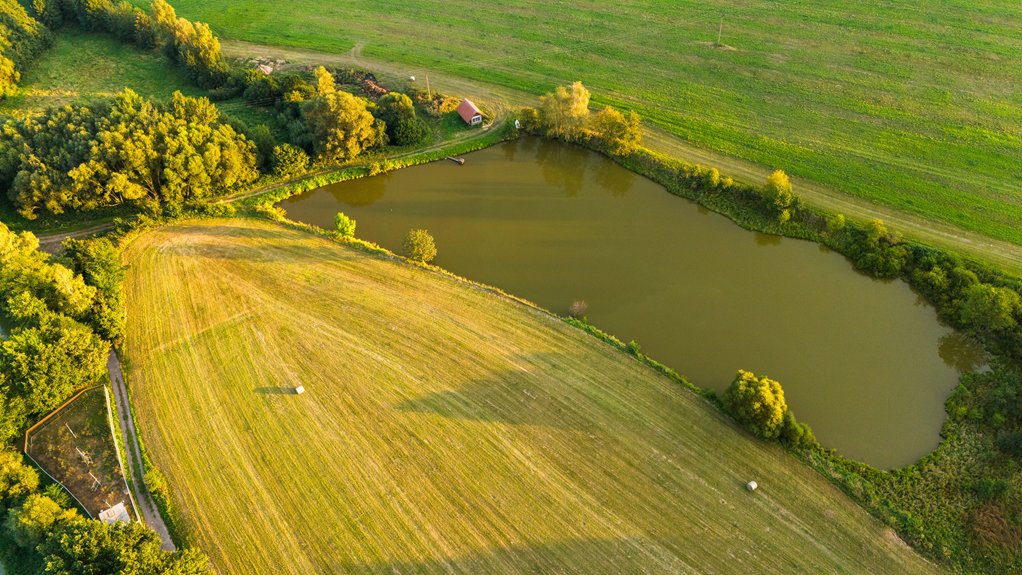
Pond and lake management on Western Pennsylvania properties must integrate glaciated and shale-dominated physiography, ~40 in/yr precipitation, and acidic, mining-impacted soils. Owners should define explicit use objectives, then regulate water levels, hydroperiod, and drainage with gauged outlets and stabilized shorelines. Nutrient budgeting (especially phosphorus), targeted alum or aeration, and macrophyte zoning are critical to prevent eutrophication, hypoxia, and harmful blooms. Adaptive monitoring of chlorophyll-a, Secchi depth, and biotic structure reveals additional strategies that optimize ecosystem services.
Although individual ponds and lakes vary widely, limnological conditions in western Pennsylvania are consistently governed by the region’s physiography, climate, and land-use patterns. Glaciated northern plateaus, dissected Appalachian uplands, and shale‑rich valleys impose contrasting watershed slopes, runoff coefficients, and groundwater-surface water exchange.
Mean annual precipitation (~40 inches) and snowmelt pulses drive flashy hydrographs, elevating sediment and nutrient loading. Acidic soils, legacy coal mining, and shale gas infrastructure introduce sulfate, metals, and altered alkalinity regimes. As eutrophication, nutrient recycling, and hypoxia become more common under these conditions, targeted, natural lake management is increasingly critical to protect long-term water quality.
Expanding exurban development, compacted soils, and tile drainage intensify stormwater surges, reshape thermal stratification dynamics, and favor eutrophication-prone, warmwater biotic assemblages.
Given these regionally constrained limnological drivers, defining explicit management objectives for a western Pennsylvania pond or lake becomes a prerequisite for effective design and operations. Owners must hierarchize use-cases—coldwater fisheries, irrigation supply, stormwater attenuation, biodiversity refugia, or recreation—because each imposes distinct constraints on nutrient budgets, shoreline configuration, habitat complexity, and allowable trophic status.
Goal-setting should be quantified: target chlorophyll-a ranges, Secchi depth, fish biomass, macrophyte coverage, and acceptable cyanotoxin thresholds. These metrics enable scenario modeling, tradeoff analysis, and adaptive management, ensuring infrastructure, habitat enhancements, and monitoring programs align with prioritized ecosystem services and regulatory risk tolerances.
Hydrologic regulation of western Pennsylvania ponds and lakes hinges on quantifying and controlling water level dynamics, inflow regimes, and drainage pathways across the contributing watershed. Innovative owners deploy staff gauges, pressure transducers, and automated data loggers to track stage–storage relationships, hydroperiod, and seasonal drawdown.
Managing inflows requires differentiating baseflow, stormflow, and overland runoff, then calibrating culverts, tile drains, and diversion channels to attenuate peak discharges while preserving ecological connectivity. Engineered outlet structures—adjustable weirs, siphon drains, and multi-level risers—enable precision control of residence time, thermal stratification potential, and spill frequency.
These structures also help route excess water toward stable receiving channels and compliant discharge points.
When unmanaged, wind setup, boat wake, and fluctuating water levels rapidly accelerate bank retreat and sediment loading along western Pennsylvania shorelines, degrading habitat structure and reducing storage capacity.
Effective stabilization integrates geotechnical engineering with bioengineering. Landowners increasingly specify coir fiber rolls, live stakes, and native deep-rooted graminoids to dissipate shear stress and enhance soil cohesion.
Rock toe protection, anchored log sills, and engineered benches break wave energy while expanding littoral habitat. Designers quantify erosive forces using fetch length, slope angle, and soil texture to select armoring thresholds.
Longitudinal buffer strips, micro-terracing, and controlled access points further reduce trampling, overland flow velocity, and bank failure probabilities.
Stabilized shorelines form only one component of resilient pond systems; in western Pennsylvania, in‑pond water quality is equally governed by nutrient dynamics, light attenuation, and macrophyte community structure.
Effective prevention of algae, nuisance weeds, and turbidity begins with watershed nutrient budgeting, especially phosphorus mass loading from lawns, agriculture, and septic leach fields.
Practitioners apply high‑frequency monitoring (Secchi depth, chlorophyll‑a, total phosphorus) to trigger interventions: alum or lanthanum treatments, hypolimnetic aeration, biochar or iron‑based filtration, and floating treatment wetlands.
Strategic macrophyte zoning, plus barley‑straw analog biopolymers, further suppress phytoplankton blooms while maintaining optical clarity and stable trophic state indices.
Although nutrient control and water clarity underpin pond function, long‑term biotic integrity in western Pennsylvania waters depends on maintaining fish and wildlife communities within the constraints of local hydrogeomorphology and thermal regimes. Managers should calibrate stocking densities of centrarchids and salmonids to empirical carrying‑capacity models integrating chlorophyll‑a, Secchi depth, and dissolved oxygen profiles.
Riparian buffers using native graminoids and shrubs enhance macroinvertebrate production and amphibian recruitment while reducing edge predation. Installation of coarse woody habitat and engineered brush bundles increases structural complexity, supporting higher functional diversity.
Continuous sensor networks (multi‑parameter sondes) enable adaptive management driven by real‑time biophysical data.
Sustaining the fish and wildlife communities described above requires a seasonal maintenance regime synchronized with western Pennsylvania’s temperate, freeze–thaw climate and precipitation patterns.
Spring: verify bathymetry, inspect ice-damage to embankments, recalibrate aeration runtimes, initiate nutrient budgeting, and deploy early-season algal monitoring.
Spring stewardship: confirm basin depths, assess winter damage, rebalance aeration, and launch nutrient and algal surveillance
Summer: track Secchi depth, temperature–dissolved oxygen profiles, macrophyte coverage, and adjust adaptive harvest of vegetation.
Autumn: manage leaf‑litter loading, stabilize inflow buffers, and benchmark sediment accretion.
Winter: maintain minimal aeration to prevent full ice‑cover anoxia, protect infrastructure from heave, and archive year‑round data to refine next season’s predictive management models.
When field observations or routine monitoring indicate trajectories toward ecological threshold conditions—such as chronic hypoxia, rapid Secchi depth decline, harmful algal bloom (HAB) onset, bank instability, or accelerated sedimentation—a professional limnologist or pond management contractor becomes a critical control point in the system.
Western Pennsylvania impoundments, with legacy nutrient loads and flashy storm events, often demand expert diagnostic tools: hydroacoustics, genetic HAB assays, and sediment-core profiling.
Owners should seek professional intervention when confronted with:
Local regulations constrain pond or lake construction through zoning overlays, hydrologic impact thresholds, nutrient-loading limits, and wetland buffers, shaping design parameters, permitting timelines, and mitigation requirements, while simultaneously catalyzing innovative stormwater reuse, biodiversity corridors, and climate-resilient, low-impact aquatic infrastructure solutions.
They typically require PA DEP Chapter 105 Water Obstruction and Encroachment permits, potentially joint U.S. Army Corps Section 404 authorization, erosion and sediment control approval, and, for hazard‑classified dams, Dam Safety permits plus engineered hydrologic–hydraulic design submissions.
They allocate lifecycle costs by modeling sedimentation rates, embankment degradation, nutrient loading, and infrastructure wear, then apply unit costs for dredging, vegetation management, structural repairs, monitoring, and contingency, discounted over 20–50 years using probabilistic risk-based asset-management frameworks.
Yes—public access and fishing trigger elevated premises-liability exposure, necessitating risk-transfer instruments: specialized aquatic-recreation endorsements, umbrella coverage, waivers, posted regulations, incident logging, and safety-infrastructure audits calibrated to visitor density, habitat sensitivity, and jurisdictional tort thresholds.
Multiple funding streams exist: USDA NRCS EQIP, FSA CREP, Pennsylvania Growing Greener, DCNR Community Conservation Partnerships, DEP Section 319 grants, CFA Watershed Restoration, and local conservation district mini‑grants targeting habitat enhancement, sediment‑nutrient attenuation, and climate‑resilient hydrologic function.
Effective pond and lake management in Western Pennsylvania is akin to updating firmware on a complex system: precise, incremental, and data-driven. Hydrologic balance, shoreline stabilization, and nutrient budgeting must be carefully quantified, monitored, and adaptively managed. When biotic integrity, trophic state indices, or sediment loads deviate from desired targets, prompt intervention is essential to preserve ecosystem services. With disciplined, science-based stewardship, private waters can maintain resilient fisheries, healthy riparian buffers, and long-term watershed health—even amidst changing regional climatic conditions. For more information on how Clean Flo can improve the health of your lake or pond, visit us online at Clean Flo. You can also check out our video series on YouTube channel.