
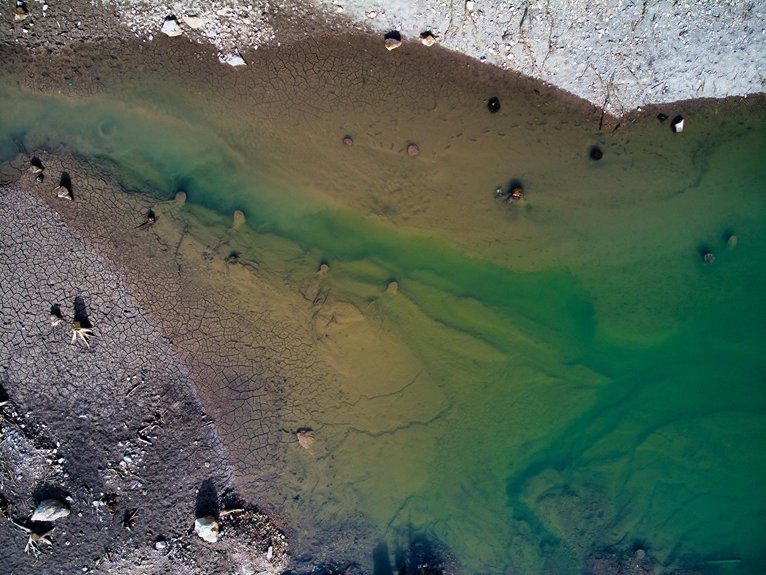
Fertilizer runoff lowers water clarity in Indian Lake, Missouri by carrying nitrogen and phosphorus from agricultural land, lawns, and storm drainage into the lake. These nutrients stimulate algae and cyanobacteria growth, which increases chlorophyll, scatters light, and reduces Secchi depth. Rainfall, snowmelt, eroding soils, and poorly buffered shorelines intensify the problem by adding sediment and organic matter. Tributary mouths and low-circulation coves often show the strongest effects, with additional patterns and solutions outlined below.
When fertilizer is applied to lawns, gardens, agricultural fields, or landscaped areas near Indian Lake, its nitrogen and phosphorus do not always remain in the soil profile. Rainfall intensity, slope, soil compaction, and drainage design determine transport pathways.
During storms, dissolved nutrients move across impervious surfaces into ditches, culverts, and tributaries; Chemical leaching carries soluble forms downward into shallow groundwater that later discharges to the lake.
Soil erosion adds another vector, attaching phosphorus to sediment particles mobilized from bare ground, construction sites, and unstable shorelines.
Monitoring across comparable watersheds shows that nutrient export rises sharply where vegetation buffers are limited and infiltration is reduced.
Implementing lake-specific water management solutions can significantly reduce nutrient runoff and help maintain water clarity. From an innovation perspective, precision application, permeable surfaces, bioswales, and real-time stormwater controls represent measurable interventions that interrupt delivery before nutrients enter Indian Lake.
Although fertilizer runoff is often invisible at the point of entry, its effect on water clarity becomes measurable once excess nitrogen and phosphorus stimulate rapid growth of algae and cyanobacteria in the lake. Before blooms become visually dominant, dissolved nutrients alter water chemistry, increasing suspended organic matter and reducing light penetration through the water column.
Monitoring data from comparable Midwestern reservoirs show that runoff also carries fine sediments, which amplify turbidity independently of biological activity. Soil erosion adds clay and silt particles that remain suspended, scatter incoming light, and lower transparency readings.
At the same time, surplus nutrients exceed normal nutrient absorption capacity in shoreline vegetation and microbial communities. This overload shifts the lake from balanced filtration toward persistent particulate loading, a pattern that informs precision watershed management and innovative runoff control strategies.
How sharply algae growth reduces visibility in Indian Lake depends on bloom density, species composition, and the depth at which cells concentrate in the water column. As chlorophyll levels rise, suspended cells scatter and absorb more incoming light, shrinking Secchi depth and limiting visual range below the surface.
Algae blooms dominated by smaller, buoyant taxa often create broader optical interference because cells remain dispersed through sunlit layers. Water pollution from fertilizer runoff amplifies this effect by increasing nitrogen and phosphorus available for rapid biomass accumulation.
Measured against baseline clarity, even moderate bloom intensity can considerably alter color, shift light penetration, and reduce image contrast underwater. For monitoring programs, pairing nutrient data with chlorophyll sensors, turbidity readings, and satellite imagery offers a more precise framework for quantifying visibility loss and guiding adaptive lake management decisions.
Periods of declining clarity in Indian Lake typically follow conditions that increase nutrient loading, suspend bottom sediments, or concentrate algal biomass near the surface. Monitoring data from comparable Missouri reservoirs indicate the sharpest visibility losses often occur after heavy rainfall, rapid snowmelt, and prolonged summer heat, especially when calm conditions reduce vertical mixing and allow algae to accumulate.
Clarity also weakens during seasonal shifts, when turnover can redistribute nutrients from deeper water into the photic zone. Agricultural practices that leave soluble fertilizer exposed before storms can intensify these episodes. Urban landscaping contributes similarly when irrigation or runoff transports nutrients from lawns into connected drainage systems.
From an innovation perspective, predictive forecasting using rainfall intensity, water temperature, and chlorophyll trends offers a practical framework for anticipating reduced transparency and timing mitigation measures.
Where runoff pressure is highest in Indian Lake generally depends on the proximity of tributary inflows, the extent of disturbed land in adjacent drainage areas, and shoreline slope. Areas near stream mouths typically receive the heaviest nutrient and sediment delivery because overland flow concentrates before entering open water. Coves with limited circulation can also register elevated inputs when nearby lots or fields drain directly toward the shoreline.
Within the watershed, Agricultural zones often contribute higher runoff volumes after rain because exposed soils and fertilizer application increase transport potential. Residential areas can become localized hotspots where lawns, driveways, storm drains, and shoreline alteration accelerate delivery.
Steeper banks further intensify movement by reducing infiltration time. From a management perspective, the highest-priority sections are inflow corridors, enclosed coves, and shorelines bordered by intensively managed land.
Runoff influences fish communities and recreation in Indian Lake primarily by reducing water clarity, elevating nutrient concentrations, and increasing suspended sediment after rainfall events. These shifts alter light penetration, suppress submerged vegetation, and disrupt feeding efficiency for sight-oriented species.
Runoff degrades Indian Lake by clouding water, raising nutrients, and increasing sediment, weakening habitat quality and fish feeding conditions.
Elevated phosphorus and nitrogen can stimulate algal growth, which later decomposes and lowers dissolved oxygen, creating episodic stress for fish health. Sediment can also smother spawning habitat and reduce invertebrate abundance, weakening forage availability across aquatic ecosystems.
For recreation, diminished clarity lowers perceived water quality, constrains swimming appeal, and can reduce angling success when fish behavior changes under turbid conditions. Boaters and shoreline users may also encounter more nuisance algae and organic debris accumulation.
Collectively, runoff-driven water quality volatility can diminish both ecological performance and the lake’s recreational value over time.
Reducing fertilizer runoff near Indian Lake requires source control, timing adjustments, and interception of nutrients before they reach tributaries or shoreline margins. Evidence from watershed management shows several high-yield strategies:
Additional controls include sweeping granules off pavement, maintaining ground cover, and minimizing compacted soils.
Collectively, these measures target nutrient mobility at the source, where intervention is most measurable, scalable, and cost efficient.
Cleaner land-management practices around Indian Lake translate into measurable gains in water clarity by lowering the nutrient and sediment inputs that drive algal growth and suspended turbidity. Buffer strips, cover crops, and calibrated fertilizer timing reduce soil erosion, intercept phosphorus, and improve nutrient absorption before runoff reaches tributaries.
Evidence from comparable Midwestern watersheds shows that even modest reductions in dissolved nutrients can increase Secchi depth and stabilize seasonal transparency.
For Indian Lake, cleaner practices also support a more resilient shoreline system. Less sediment deposition preserves shallow habitat, while lower nitrogen and phosphorus loads reduce bloom frequency and duration. The result is a clearer, more predictable water column that benefits recreation, fisheries, and monitoring accuracy.
From an innovation perspective, preventive watershed management delivers scalable, lower-cost clarity improvements than repeated in-lake remediation efforts alone.
Yes, fertilizer runoff can reduce property values around Indian Lake MO by degrading water quality and recreational appeal. Data-driven mitigation through improved Landscaping practices and Organic alternatives may protect shoreline desirability, market resilience, and long-term valuation trends.
Yes, local fertilizer regulations may apply near Indian Lake through county ordinances, Missouri water-quality rules, and shoreline standards; verification requires municipal and watershed sources. Effective runoff management typically reflects nutrient limits, setback requirements, and enforcement mechanisms.
Water clarity at Indian Lake is professionally measured through Water testing protocols, Secchi disk depth readings, turbidity sensors, and laboratory analysis. This clarity assessment generates repeatable, evidence-based metrics that support analytical monitoring, trend detection, and management decisions.
Yes, septic failure can reduce Indian Lake water clarity by increasing water contamination, nutrients, pathogens, and suspended solids. Evidence links malfunctioning systems to algal growth, turbidity, and diminished transparency, warranting monitoring, diagnostics, and infrastructure modernization.
Residents should contact the Missouri Department of Natural Resources, county health department, and local watershed or lake authorities about suspected runoff pollution. Stormwater management records and Agricultural practices data help agencies assess sources and prioritize interventions.
Fertilizer runoff remains a measurable factor contributing to reduced water clarity at Indian Lake, MO, as the added nitrogen and phosphorus promote algae growth, increase suspended organic matter, and diminish visibility during warm, wet periods. Studies of freshwater systems indicate that phosphorus levels as low as 0.03 mg/L can stimulate algal blooms, leading to noticeable declines in water clarity. Improving runoff control can result in clearer water, healthier habitats, and more consistent recreational conditions across the lake. For more information on how Clean Flo can enhance the health of your lake or pond, visit us online at Clean Flo. You can also explore our video series on YouTube channel.